When a fine-tuned open model beats GPT or Claude on specialized production tasks.
Frontier for exploration. Specialists for scale. A practical model strategy for production AI.
The question is not which model is biggest.
The right question is: which model gives the best result for this specific job, at the right cost, latency, and control level? That framing is what separates a clean prototype from a system that actually operates at scale.
Frontier model
Best for first prototypes, broad reasoning, unknown edge cases, and tasks without enough labeled data to train on.
Fine-tuned open model
Best when the task is stable, repeated, domain-specific, and measurable with a clear evaluation set.
GPT and Claude are often the best way to start. They are not always the best way to operate at scale.
A simple analogy.
A frontier model is a brilliant generalist. It can reason broadly, handle ambiguity, and help you discover the right solution quickly.
A fine-tuned open model is a trained specialist. It learns your exact terminology, format, edge cases, and quality bar. On repeated work, that specialization can beat a generalist.
Use the generalist to learn. Use the specialist to scale.
What the published evidence says.
Three independent studies from 2024 and 2025 tell the same story from different angles. None of them claim that small models are universally better. All of them show that for the right task, a fine-tuned open model can win on the metric that matters.
Fine-tuning creates task-specific lift.
Across 31 tasks measured in Predibase’s LoRA Land report, most base models improved substantially after task-specific fine-tuning. The message is specialization, not model size alone. A smaller model can become a stronger production worker when it is trained on the exact job you care about.
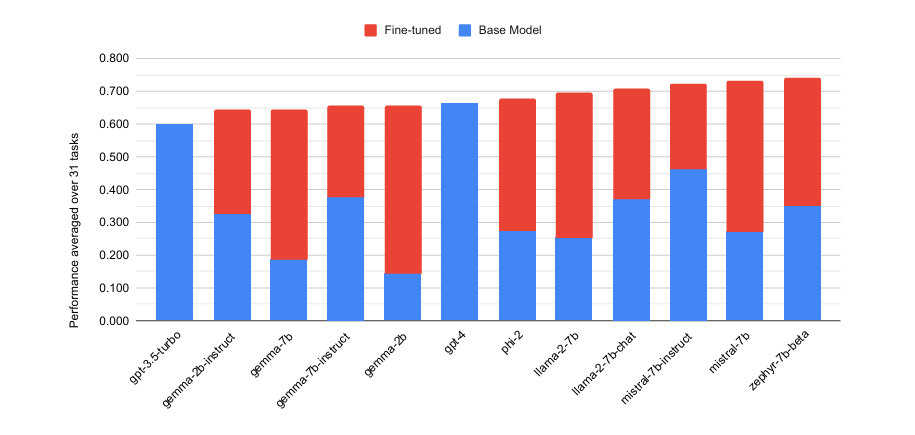 Base model (blue) versus the same model after LoRA fine-tuning (red), averaged over 31 tasks. Source: Predibase LoRA Land, 2024.
Source: Predibase LoRA Land, arXiv:2405.00732 (2024).
Structure errors are production failures.
For structured outputs like workflow JSON, the output must be valid, not just fluent. In a ServiceNow workflow-generation benchmark:
- Fine-tuned Mistral-Nemo-12B: 5.6% errors on test, 1.0% out-of-distribution.
- GPT-4o: 17.3% test, 11.0% out-of-distribution. For enterprise automation, the winning model is the one that follows your schema and business rules most reliably.
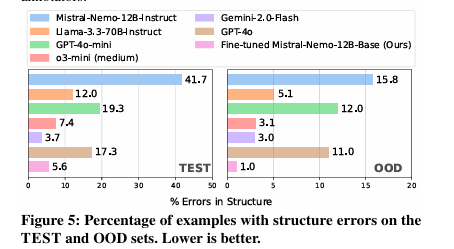 Percentage of structure errors on TEST and OOD evaluation sets. Lower is better. Source: ServiceNow / KDD Workshop 2025, Figure 5.
Source: ServiceNow / KDD Workshop 2025, arXiv:2505.24189.
Fine-tuning can reverse the ranking.
In a healthcare scribing case study, the open model started behind the frontier baseline, then became the top performer after task-specific training:
- Gemma 3 27B, base: 34.6% pass rate.
- Claude Sonnet 4: 53.2% pass rate.
- Gemma 3 27B, fine-tuned: 85.1% pass rate. The model did not become universally smarter. It became much better at this one job.
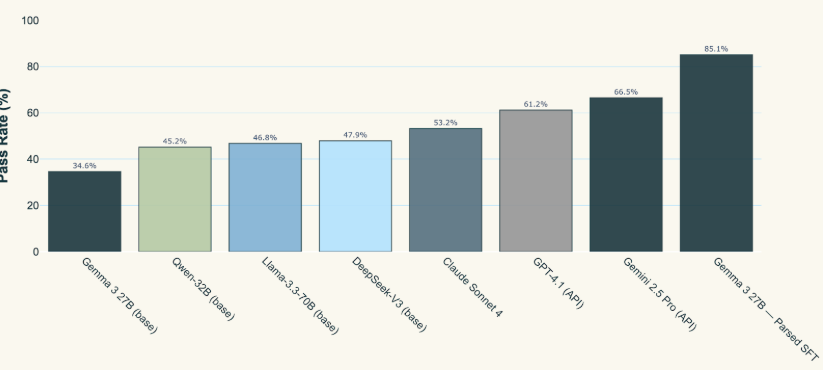 Pass rate by model on the scribing benchmark. Gemma 3 27B starts behind the frontier APIs and ends as the top performer after fine-tuning. Source: Together AI / Parsed, 2025.
Source: Together AI / Parsed healthcare scribing case study (2025).
Relative performance on the scribing task, with Claude Sonnet 4 = 100.
Where fine-tuning is most likely to win.
The pattern is consistent across all three studies: stable task, clear examples, measurable quality, high repetition. A specialist wins when the output distribution is narrow. This is common in production. The business does not need a model to answer every question in the world. It needs the model to do one workflow extremely well.
JSON, XML, tables, forms, templates, controlled wording.
Medical, legal, finance, internal product names, enterprise process rules.
Support classification, document extraction, invoice parsing, routing.
Customer-specific voice, note format, report structure, compliance phrasing.
Fine-tuning bakes repeated fixes into the model instead of growing the prompt forever.
Serve inside your environment and control where sensitive data flows.
Why fine-tune at all? Accuracy is not the only reason.
Production success is not just model score. It is control, security, cost, latency, and reliability. Fine-tuning a smaller open model on your task gives you a different set of tradeoffs than a frontier API:
- Serve the model in your own environment or preferred cloud.
- Keep sensitive data under tighter governance and audit controls.
- Lower per-call cost for high-volume workflows.
- Reduce latency with a smaller task-optimized model.
- Update the model when the business process changes.
- Reduce vendor lock-in and keep version control.
The customer gets a model shaped around their workflow, not a generic model asked to behave like one.
A decision guide.
Neither approach is universally correct. The choice depends on whether the problem is still moving or has settled into a repeatable production task.
- Requirements are still changing.
- Broad reasoning, research, or multi-domain questions.
- Low volume, where training effort does not pay back.
- Limited labeled data or no reliable evaluation yet.
- Workflow is stable enough to define examples.
- You can build a gold test set and clear pass-fail checks.
- Schema, format, style, and terminology matter.
- You have enough representative examples to train on.
- High volume, so savings compound over time.
- Privacy, auditability, and vendor independence matter.
When these conditions are true, a smaller fine-tuned model is often the better production model.
Is your workflow a fit for this pattern?
We do paid discovery, not unpaid pilots. If your team is running a stable, high-volume workflow on a frontier API and the cost or control is starting to hurt, that is exactly where this conversation pays back.
References
- ServiceNow / KDD Workshop 2025. Fine-Tune an SLM or Prompt an LLM? The Case of Generating Low-Code Workflows.{’ ’} arXiv:2505.24189
- Predibase, 2024. LoRA Land: 310 Fine-tuned LLMs that Rival GPT-4, A Technical Report.{’ ’} arXiv:2405.00732
- Together AI / Parsed, 2025. Fine-Tuning Small Open-Source LLMs to Outperform Large Closed-Source Models by 60% on Specialized Tasks. Caveat: results depend on data quality, evaluation design, task stability, and strong baselines. Fine-tuning should be proven with a pilot, not assumed.